
School lets out at three. Work ends at six. What happens in between decides more about a child's year than most people outside education realize — whether homework gets done, whether a struggling reader catches up, whether a teenager is somewhere safe, whether a child eats a real meal before bedtime.
I have spent thirty years in public education, and since 2018 I have run an after-school and summer program in West Point, Mississippi. I know what those hours cost to staff well. I also know that most of the organizations already doing this work — churches, community centers, small nonprofits — are covering it out of tithes, fish fries, and the director’s own pocket.
They rarely know there is a federal program built for exactly this. And when they do hear about it, they usually assume they are not the kind of organization that qualifies.
They almost always are.
What 21st CCLC actually is
The Nita M. Lowey 21st Century Community Learning Centers program — everyone calls it 21st CCLC — is the only federal funding stream dedicated exclusively to before-school, after-school, and summer learning. It has been running for close to three decades and is currently funded at $1.329 billion a year.
It is authorized under Title IV, Part B of the Every Student Succeeds Act, and it works differently from the federal programs most people picture. Washington does not run the competition. The money goes to each state education agency, and the state runs its own grant competition, sets its own deadlines, and writes its own scoring rubric.
That single fact explains most of the confusion around this program, and I will come back to it.
Who is eligible — including you
This is where organizations disqualify themselves for no reason. The eligibility language is deliberately broad. In Mississippi, where I work, the state’s own guidance says any public or private organization may apply, and then names examples:
Eligible applicants
- School districts
- Non-profit agencies
- City or county government agencies
- Faith-based organizations
- Institutions of higher education
- For-profit corporations
Other states use similar language. Check your own state agency's request for proposals for the exact wording.
Read that fourth line again, because it is the one that surprises people. Faith-based organizations are named explicitly. If your church runs an after-school ministry, a homework club, a summer day camp, or a tutoring program in the fellowship hall, you are looking at an eligible applicant.
I want to be precise about what that does and does not mean, because the concern underneath the question is a real one. Federal funds will not underwrite worship, religious instruction, or evangelism. They will underwrite the academic enrichment, the tutoring, the STEM activities, the staff who supervise them, and the space they happen in. Congregations run some of the most consistent youth programming in this country, in the neighborhoods where it matters most. The program was written with them in mind.
The most common reason a qualified organization does not receive this money is that it never applied.
What the money pays for
The grant is unusually flexible, which is part of why programs that have it hold onto it. Funds generally support academic enrichment during non-school hours, with priority for students attending high-poverty, low-performing schools. In practice, that covers:
- Tutoring, homework help, and reading and math intervention
- STEM and technology programming
- Arts, music, and enrichment activities
- Physical activity and athletics
- College and career readiness, and youth workforce programs
- Counseling, mentoring, and violence prevention
- Staff salaries, professional development, transportation, and supplies
- Family engagement and adult literacy for the parents of enrolled students
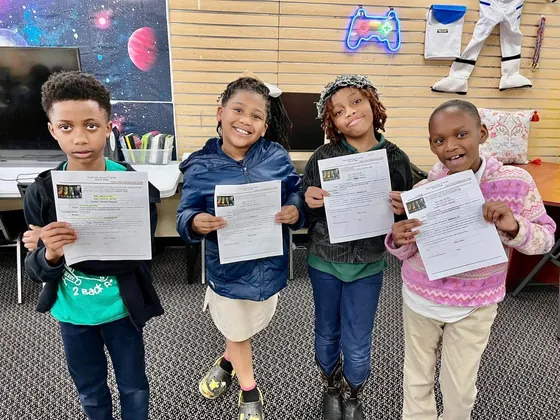
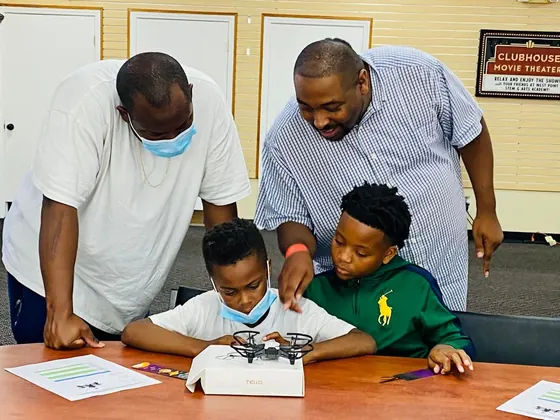

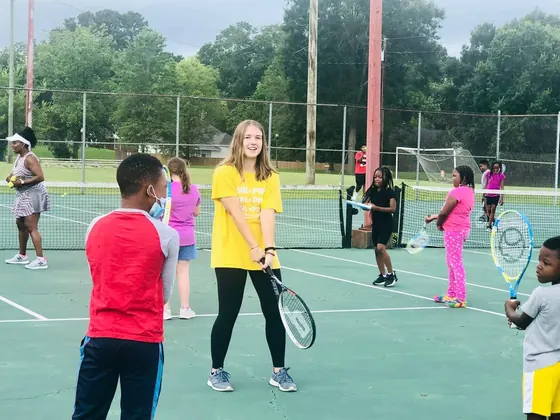
All four photographs are from Tech Generation Learning Center — the after-school and summer program I founded and direct.
It is worth pausing on staff salaries. Most small programs are not short of willingness. They are short of a person whose actual job this is. This grant pays for that person.
The part nobody plans for
Here is the detail I most wish someone had put in front of me early, and the reason I am writing this as a notice rather than an explainer.
Awards typically run multiple years — and in many states, including Mississippi, the funding declines on a fixed schedule. Mississippi funds programs across four years on what the state calls a degrading scale:
The award shrinks on a fixed schedule
Share of the original award, by year — Mississippi's four-year "degrading scale"
| Award year | Share of original funding | Change |
|---|---|---|
| Year 1 | 100% | — |
| Year 2 | 100% | — |
| Year 3 | 80% | −20% |
| Year 4 | 60% | −40% |
Continuation is also contingent on proper implementation, complete reporting, and future congressional appropriations. None of it is automatic.
What this means practically: the program you can afford in year one is not the program you can afford in year four. Every director I have watched struggle with this grant hit the same wall at the same moment — year three arrives, the budget drops by a fifth, the staff and the families are already counting on the program, and nobody built the plan to cover the gap.
Write the sustainability plan in year one, when the money is easiest and the pressure is lowest. Diversify early. Reviewers ask about this for a reason, and a serious answer strengthens the application on the way in.
There is no national deadline
Because every state runs its own competition, the cycles are genuinely unrelated to each other. As of this year, one state’s application window closed in April for a three-year award period. Another expected to post an opportunity in the spring for programs opening that fall. A third scheduled its next competition for the winter of 2026–2027. A fourth announced no competition at all for the coming school year.
So the question is never “when is the 21st CCLC deadline.” It is: when is my state’s next competition, and what does my state’s rubric reward?
Find your cycle
Go to your state department of education's website and look for Federal Programs, Title IV Part B, or 21st CCLC directly. That office publishes the request for proposals, the scoring rubric, and the timeline. Get on their notification list even if you are not ready to apply — competitions are often announced with short windows, and preparation is the whole game.
In Mississippi, that is the Mississippi Department of Education's Federal Programs office.
Stack the food program with it
One more piece of money that routinely goes unclaimed. If you are feeding children — and if you run an after-school program, you almost certainly are — the Child and Adult Care Food Program reimburses meals and snacks served in after-school settings.
I have met directors buying groceries with program funds while sitting on an unclaimed CACFP reimbursement, and directors who assumed the paperwork was heavier than it is. These two programs were designed to work together: 21st CCLC funds the programming that brings children through the door, and CACFP covers the supper they eat when they get there.
What makes an application competitive
I write these proposals for other organizations, and I answer to one myself. The applications that score well tend to share the same features:
- A real needs assessment. Name the schools your children attend, cite their performance data, and show the gap you are closing. Reviewers can tell instantly whether you know your community or are describing it in general terms.
- Genuine partnerships. A letter of support from the school district carries real weight. So does a library, a community college, a health provider. Get commitments in writing early — this is the piece that most often runs out of time.
- An evaluation plan with actual measures. Not “students will improve.” Which students, measured how, compared to what, reported when. This is where most otherwise-strong applications lose points.
- A staffing plan that survives contact with reality. Who runs the program on a Tuesday in February when two staff are out. Reviewers with operating experience read for this.
- A sustainability plan that acknowledges the declining scale. See above. Naming it directly signals that you have read the terms and intend to still exist in year five.
One honest caution
This funding has been politically contested in recent years. A recent federal budget proposal sought to eliminate its dedicated status, and congressional appropriators restored it. Funds have been temporarily withheld and then released. Congress has maintained the line, but nobody should treat a $1.3 billion appropriation as permanent scenery.
I raise it for one practical reason. If your organization is eligible and the work is already happening, the argument for applying in the current cycle rather than the next one is stronger than it looks. Grants awarded are considerably harder to unwind than grants not yet applied for.
What to do this month
- Write down what you already run in the after-school and summer hours, how many children it serves, and which schools they attend.
- Find your state education agency’s 21st CCLC page and get on the notification list.
- Download the most recent request for proposals, even an expired one. The rubric rarely changes much, and it tells you what to build toward.
- Ask your school district for a letter of support before you need it.
- If you are a church without a nonprofit arm, start that conversation now. It takes longer than the grant window allows.
None of this requires a development office. It requires knowing the program exists and starting before the window opens.
The hours between three and six belong to somebody. In a lot of communities, that somebody is a church basement, a rented storefront, or a retired teacher who never learned there was funding for the thing she has been doing for free since 2009.
There is. Go get it.
Dr. Martha Liddell, Ed.D. is Chief Marketing Strategist and Grants Specialist at Roberts Innovation Group and founder and Executive Director of Tech Generation Learning Center, an after-school and summer program in West Point, Mississippi. She works across the P-21 continuum with HBCUs, K-12 schools, faith-based organizations, and out-of-school-time providers.
Sources: Afterschool Alliance · Mississippi Department of Education, Federal Programs · National AfterSchool Association